



Blog
Korrodin Screw Icon Takes a Closer Look – Today: Inspection Certificates According to EN 10204: 2.1, 2.2, or 3.1?
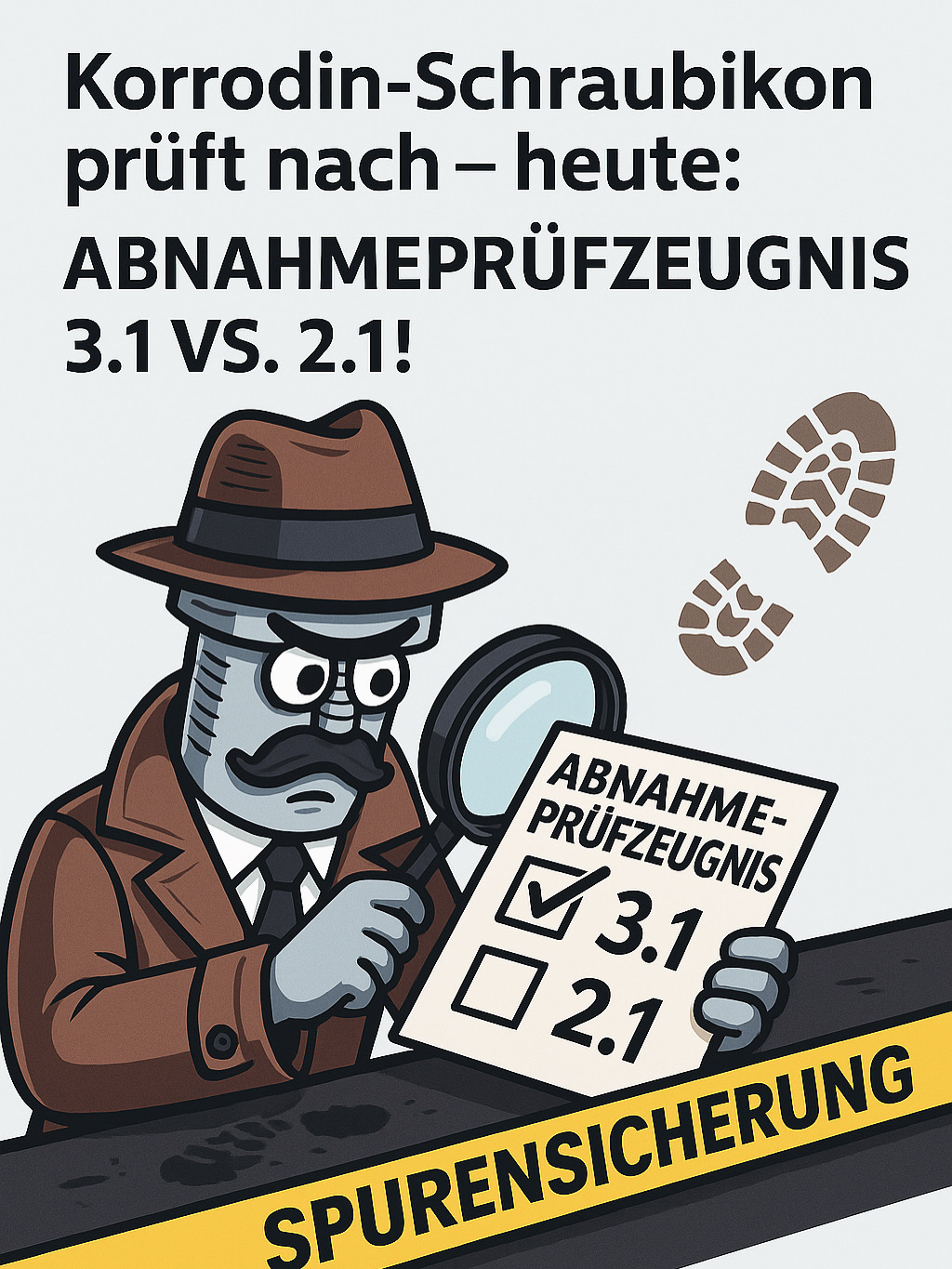
Inspection certificates are often requested after the fact, misunderstood, or underestimated, even though they are a key part of quality assurance and traceability. The EN 10204 standard defines different types of certificates that vary significantly in terms of the information they provide and their intended applications.
What Is an Inspection Certificate?
An inspection certificate is documented proof that a product—such as a screw—meets the agreed technical requirements. However, the level of detail, verifiability, and traceability can vary depending on the certificate type.
Type 2.1 – Manufacturer’s Declaration
–Content: Confirmation from the manufacturer that the product meets the agreed requirements
–Test results: No specific measurement or analysis results provided
–Traceability: No assignment to a specific batch
–Applications: Standard screws and applications without increased safety or documentation requirements
Type 2.1 is the simplest form of documentation and primarily serves as a formal confirmation of conformity.
Type 2.2 – Test Report
–Content: Confirmation of conformity based on non-specific inspections
–Test results: May be included, but are not necessarily specific to the batch
–Traceability: Limited, usually without clear batch traceability
–Applications: Applications with higher quality requirements where full batch traceability is not required
The 2.2 certificate is an intermediate level: more informative than 2.1, but less detailed than 3.1.
Type 3.1 – Inspection Certificate with Test Results
–Content: Actual test results (e.g., chemical composition, mechanical properties)
–Test basis: Tests performed on the supplied batch
–Traceability: Clear traceability via the batch or heat number
–Issued by: The manufacturer, authorized by an independent inspection representative
–Applications: Safety-critical applications, e.g., mechanical engineering, pressure equipment, and energy, aerospace, and space technology
In many regulated and standards-based applications, a 3.1 certificate is mandatory.
The Screw Icon’s Verdict
No certificate is inherently better or worse—it simply depends on the application.
The important thing is that the required certificate type must be defined before the order is placed. Issuing a certificate after the fact is often only possible with considerable effort, or may not be possible at all.
Key takeaway:
2.1 confirms, 2.2 reports, 3.1 documents—and provides the highest level of safety and traceability.